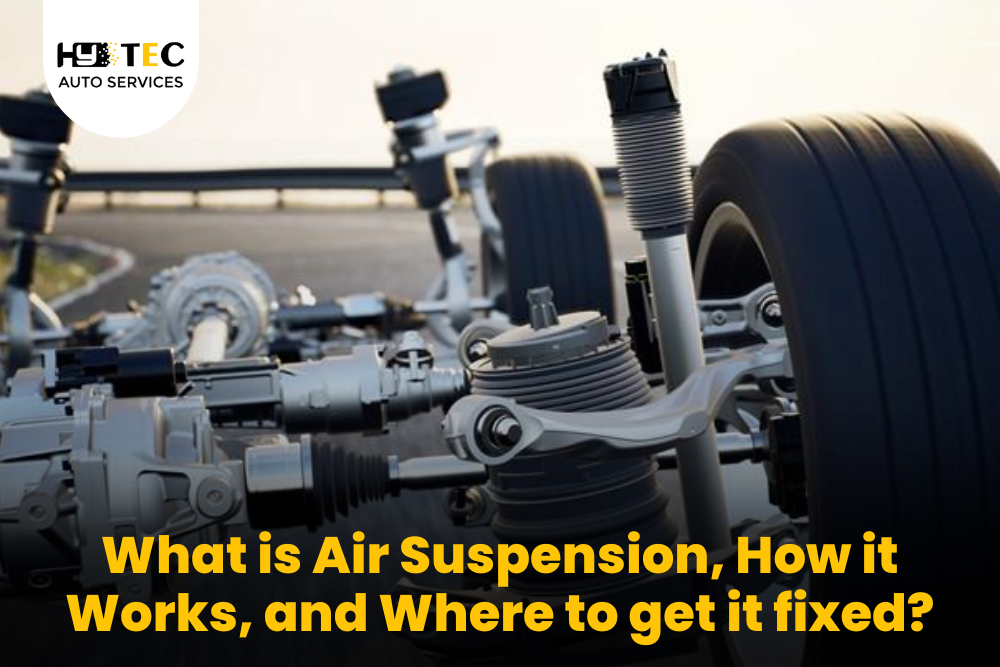
Air suspensions are a particular type of suspension, characterized by the possibility of being powered by an electric pump or a motor compressor. The goal common to all types of suspension is to keep the mass of the vehicle suspended on the tires. There are various fields of application of air suspensions, but the main use is found in cars, instead of using the classic steel springs, therefore also in trains, semi-trailers, trucks, and buses, therefore heavy vehicles in general.
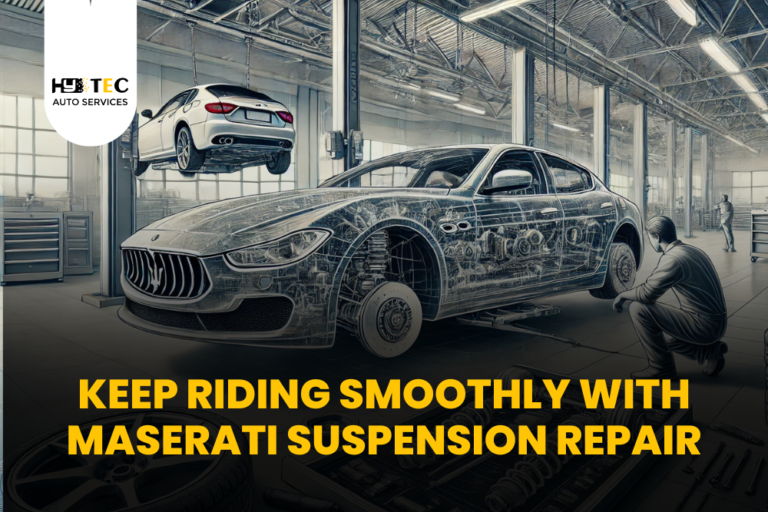
Car suspensions include all the parts that allow the chassis and body to be connected to the vehicle’s wheels. Suspensions use a series of components that allow the chassis to move relative to the tires, such as the spring and wishbones, but we also have shock absorbers, which, on the contrary, lead to the slowing down and damping of movements.

Air Suspension: What It Is and How It Works
When we talk about air suspensions we mean an entire air system, made up of different components. Compared to traditional suspensions, air suspensions replace the spring-shock absorber function, being made up first of all of an air bellows, which takes on the role of the coil spring, keeping the car raised to a certain height and of other parts, such as:
- The electric compressor generates pressure on the air in the circuit
- Oil-gas shock absorber, has the function of a classic shock absorber, damping the oscillations of the vehicle
- Air accumulator prevents the compressor from being activated frequently
- The valve group directs the compressor air to the springs that need it
The system also includes an electronic system, connected to the vehicle’s switches and sensors, to regulate the airflow by adjusting the air pressure in the bellows, and pipes, which channel the compressed air.
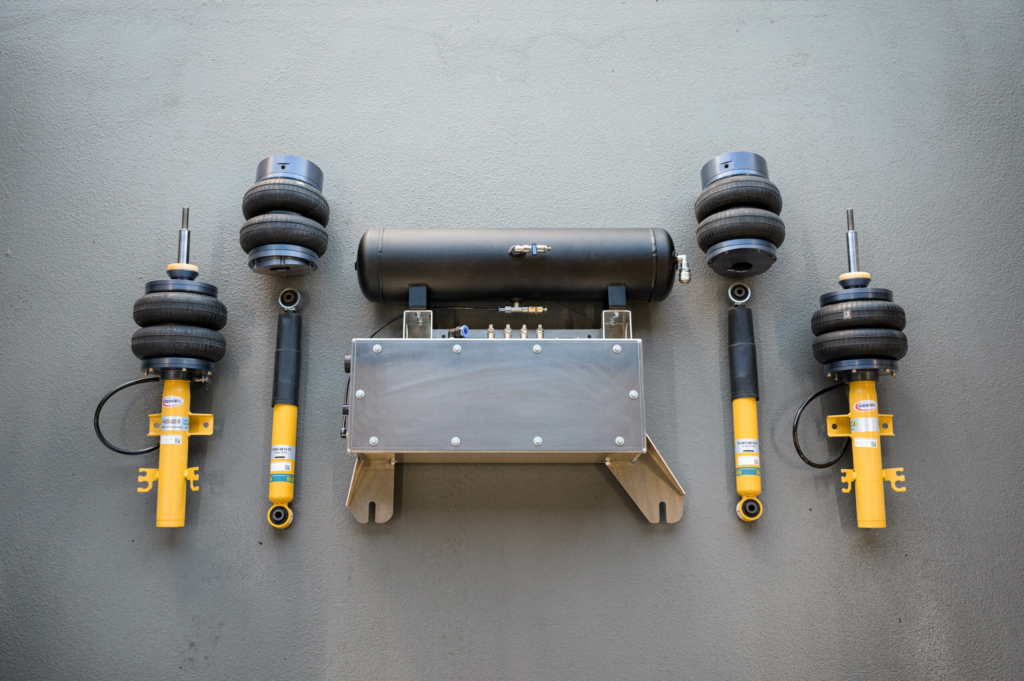
As for the operation of air suspension for cars, it is essentially based on the air bellows that replace the spring. It is a sort of rather resistant “lung” made of elastomer, inside which a variable quantity of air is stored. The tasks of the bellows are the same as those of the spring, while the pneumatic shock absorber dampens the typical stresses of the road, as does a traditional oil or gas shock absorber.
In fact, the amount of air in the air spring is regulated by an electronic system, which acts according to the set-up required and the terrain being driven on. We are almost talking about an adjustable spring, capable of taking on different shapes depending on the needs, so as to best adapt the car to the driver’s driving style and the road. In this way, it is as if the coil spring was able to change its diameter, stiffness, number of coils, and thickness at any time.
Are You Struggling To Find Best Suspension Repair Near You?
What are the types of suspension?
The goal common to all types of suspension is to keep the mass of the vehicle resting on the tires suspended, with a neutral trim, so as to eliminate pitching and rolling as much as possible, regardless of the roughness of the road and driving conditions.
In general, we have four types of air suspension: active, passive, adaptive semi-active, and selective.
Active suspensions
consist of automatic systems that regulate and monitor the movement of the suspended and unsprung masses constantly, regardless of the state of the road surface. They do not have a traditional spring, so it is possible to adjust them in terms of damping and stiffness.
Passive suspensions
are those in which the movement of the suspended masses and the wheel is conditioned only by the ground. We are therefore talking about the spring-shock absorber system, in which the different characteristics of these two components are fixed and it is not possible to adjust them in any way subsequently, such as damping capacity, spring stiffness, and number of coils.
The adaptive or semi-active ones
represent a sort of middle ground between the passive and the active ones, considering that they are equipped with a conventional spring, whose stiffness is unchangeable, and an oil shock absorber, which is controllable by adjusting the passage section of the holes, therefore it is possible to change the damping.
The Selective Ones
are the simplest type, as they allow you to modify the damping based on the road surface conditions, but, due to the presence of the helical spring, the stiffness is fixed. As for the shock absorber, it is a classic gas-oil twin-tube, which does not use the support of sensors, valves, compressors, or control units.
Advantages of Air Suspension?
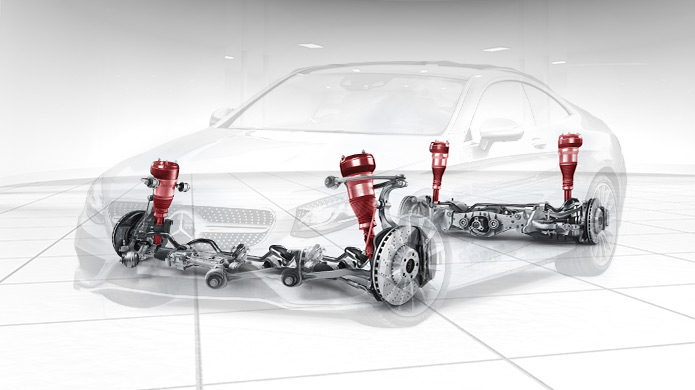
Air suspension is a particular type used especially in high-end car brands, such as Audi, BMW, Mercedes, Land Rover, and Tesla. The advantages related to the use of air suspension are undeniable.
First of all, they allow the adjustment of the height from the ground of the vehicle, based on the load conditions, which vary depending on the model. In addition to this, we have better driving comfort, with the car that will suffer less from the consequences of the roughness of the ground, reducing the jolts. Finally, we highlight the better braking performance and greater road holding, thanks to the continuous adjustment of the trim, so as to enjoy greater safety.
Conclusion: Where to Get it Fixed
The air suspension system is more precise and responsive, but also more expensive than traditional solutions that rely on the mechanical response of springs. The combination of compressors and bellows offers a wide range of adjustments, but installation on a vehicle is not always possible and involves costs to be evaluated.
You can get your car’s Air Suspension fixed at Hytec Auto Garage in Dubai. Hytec is one of the best local car repair garages that has been providing repair services since 2002 and has the certified mechanics to get your car back on the road. Call Hytec Autos now and experience the difference.